The Rise of Intelligent Products
Why the Software of Yesterday Cannot Solve the Problems of 2026

For the past so many years, software has proved to be very reliable for us but it has never offered us any flexibility. You are required to give it an instruction and as per your instruction, it will perform a task that was hardwired in its coding. But we have often seen in many teams that this static model becomes a business bottleneck and 2026 has brought it to an end. The rigid software logic will soon not be able to keep up with the volatile marketplace that we navigate today.
And this is when AI products will emerge and rule over the market. These are different from the traditional tools that we have used for such a long time. An AI product is built on the basis of probabilistic reasoning which means that while it stores data like traditional software, it has additional abilities. It can recognize patterns from that data and based on those trends, predict needs that have not yet arisen. We are currently witnessing a gigantic shift toward autonomous software systems that have the ability to learn and optimize themselves constantly.
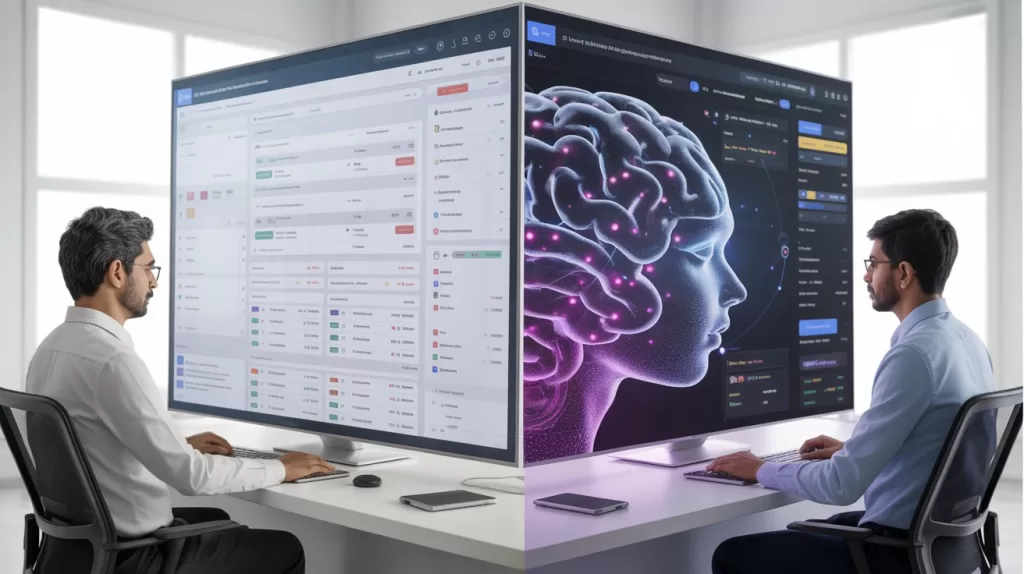
Intelligent Applications vs Traditional Software
If we consider 2026, the gap between the software that we have always used and the intelligent applications that have now started to emerge has widened at a huge pace. While traditional software is characterized as reactive (it waits for the user to click a button or input some data), intelligent applications are highly proactive.
Hence, we call them Software 2.0. As per the traditional development methodologies, developers wrote every single line of logic. And if a business case ever got changed, the code had to be manually rewritten by the team. But with AI-native applications entering the landscape, logic is now learned from data. Hence, the software can effectively update its own understanding of all your business needs in real-time while learning from its mistakes.
| Feature | Traditional Software | Intelligent Applications |
|---|---|---|
| Logic & Execution | Fixed rules that would require manual updates. | Dynamic logic that updates itself as per new data. |
| Handling Data | Acts as a repository enabling record-keeping. | Acts as an engine providing predictive insights. |
| User Engagement | Standardized interface for all users. | Personalized experience customized for specific needs. |
| Scalability | Requires more human supervision over time. | Increases its own efficiency using self-optimization. |
| Business Role | A reactive tool that is used to perform specific tasks. | A proactive tool that acts as a partner in decision-making. |
Be it any business (a startup or an enterprise), the biggest difference is caused by the feedback loop. Traditional software remains the same on Day 1,000 just like it was on Day 1. On the other hand, an AI product becomes much more valuable after every interaction.
Therefore, by choosing intelligent product solutions over legacy systems, many businesses are leaving their traditional processes behind to build advanced intelligence-based ecosystems.
Is Your Software Holding You Back?
Find out if your current software is ready to evolve into an intelligent product.

Pillars of AI-Native Applications
Building an AI-first product requires a fundamental shift in how the software gets structured from scratch and then gets built. The most successful intelligent products always are built upon foundational pillars which allow these software solutions to outperform in comparison to traditional legacy systems.
From our experience with real projects, demand usually increases as a product scales. That is when performance, structure, and code quality start to matter more than just speed.
Because of this, hiring skilled developers becomes competitive, and pricing can vary a lot.
AI-Native Application Capabilities
Result-Focused:
Autonomous software systems are not like our traditional software that would wait for the user’s command to begin their work. They will understand the final goal first and then determine the exact steps that would be needed to reach it.
Action-Oriented:
We are quickly moving from tools that demonstrate and show data to agents that are capable of drawing patterns and insights from data to make accurate predictions. Hence, now your software will be able to initiate processes without requiring any manual triggers.
Self-Correcting Logic:
With the help of constant feedback, AI-native applications are able to refine their own internal rules based on your demands, business data and while learning from its mistakes.
Increased Accuracy:
While traditional software depreciates over time becoming obsolete by a point, an AI product keeps on growing in value as it continues to constantly accumulate data and improve its accuracy based on it.
Contextual Understanding:
This advanced AI system first understands the user’s business environment and then adjusts all its responses, decisions and actions to customize them as per your data, needs and objectives.
Personalized User Experience:
The interfaces of these AI applications have shifted from that of static software. They change themselves dynamically in order to provide exactly what the user would prefer for any specific task.
Proactive Problem Solving:
AI systems have the ability to give early warnings. This is because instead of waiting for a bug or an error, these systems identify all the potential bottlenecks and alert the team before anything gets escalated.
Integrated Learning Loops:
The software learns from its own mistakes and successes which leads to reducing the need for developer supervision in the future of software development 2026.
AI Best Practices for 2026
If your goal is to transition to an AI-first product strategy, it would require far more effort and considerations than expected. In 2026, the businesses that successfully implement autonomous software systems are deemed to follow these core principles in order to make sure that their investment provides some real value:
Define the Problem First (Internal Link: AI Consulting Service Page):
No matter what, avoid the trap of adding AI for the sake of it. You are supposed to identify a specific business bottleneck (maybe slow response times or high manual data entry) and once you have that in mind, build your AI product in a way to solve that problem.
Focus on Data Quality:
Your software can only be as smart as the information it was fed at the time of training. Hence, clean and well-organized data is the most important fuel for intelligent product solutions as without it, even the best models are deemed to fail.
Keep Humans in the Loop:
Now, that could be a tricky one. But it’s important to duly realize that the goal of an AI-native application is not to replace your team but to augment it. Always make sure that there is a human to handle all the high-stakes decisions and edge cases.
Start Small and Scale Fast:
It’s alright to begin with a “Minimum Viable AI“. So you can launch a single and high-impact feature first, measure its performance and then expand into more complex autonomous software systems once you see some measurable output.
Prioritize Model Flexibility:
The AI hype moves at a staggering pace. Building your software with a modular design can help you easily swap out the underlying AI brain as newer and faster models become readily available.
Monitor for Drift:
Unlike traditional software, AI performance can change over time. So, regularly auditing your systems in order to make sure that the software’s logic stays accurate and in alignment with your original business goals.
Privacy by Design:
In 2026 with AI, security is absolutely non-negotiable. Hence, make sure that your AI-first products include built-in guardrails in order to protect sensitive customer data and maintain user trust from day one.
Core AI Use Cases
In 2026, we are seeing how AI is changing software development with the help of functional shifts that can apply to any organization. Whether you are a small startup or a global enterprise, these examples of AI-powered products strongly represent the new standards of quality and efficiency that will be expected in products.
Predictive Analytics:
Moving far beyond simple reporting, an AI product efficiently analyzes all the relevant historical data in order to predict future trends in order to allow businesses to get themselves prepared for the market shifts that are yet to come.
Deep Research & Synthesis:
Intelligent applications have the capability to scan through thousands of documents, transcripts as well as reports in just a few seconds in order to provide a concise summary which drastically reduces the time that is spent on market research.
Automated Software Development:
With the help of AI product development tools, teams can now easily automate writing boilerplate code and the detection of all the security vulnerabilities which speeds up their path to launch.
Hyper-Personalization:
In the current scenario, systems use AI-first products in order to alter the content of websites, emails and product recommendations in real-time based on the user’s behavior and preferences.
Intelligent Process Automation:
Software systems that are autonomous have the ability to handle complex processes that require decision-making such as processing insurance claims or approving complex invoices.
Predictive Maintenance:
For businesses having physical assets, intelligent product solutions monitor the sensor data in order to predict exactly when a machine or server will fail and then scheduling a fix before any downtime occurs.
Advanced Threat Detection:
Cybersecurity tools now use the new Software 2.0 logic that helps identify and block all the new types of digital attacks by recognizing suspicious patterns early rather than waiting for a known virus signature.
Natural Language Interaction:
Modern AI-native applications allow users to interact with complex databases with the help of plain English, therefore, making advanced data analysis accessible to everyone in the company.
Sentiment & Brand Monitoring:
AI products are now capable of tracking millions of social conversations and reviews in order to give brands a detailed and exhaustive analysis on how the public perceives their latest move.
Dynamic Resource Optimization:
From managing energy usage in an office to optimizing server loads for a website, autonomous software systems adjust resources in real-time in order to minimize costs and maximize performance.
Your AI Product Readiness Checklist
We at Tech Formation recommend that before committing any resources to AI, you can make use of the following questions to analyze your business foundation and readiness for AI.
Find the Problem:
Have you until now pinpointed a specific manual process or problem that an AI product can help solve?
Check Your Data:
Is your business data centralized and accessible, or is it trapped and mixed up?
Clean Your Data:
Is your current data clean and relevant enough so that an AI system can be trained on it?
Define Success Metrics:
Have you set any clear KPIs in order to measure the ROI of your intelligent products?
Review Your Technical Debt:
Is your current software flexible enough to integrate with modern AI logic or is it about to become obsolete?
Get Your Team Ready:
Does your leadership know that after AI’s one-time setup, regular checkups shall be required?
Establish Security Protocols:
Have you drafted any privacy guardrails that would protect your customer’s data?
Plan for Human Oversight:
Do you currently have a team that is ready to monitor and refine the AI’s decisions?
Watch the Cost:
Will your bill stay manageable as you add more users? Or will there be any cost spikes?
The Bottom Line
By the end of 2026, we can predict that the gap between businesses using traditional software and the ones running on Software 2.0 will widen.
But building an AI-first product in real-time would be a long journey requiring constant improvement. Everything would change, the way we view our data today, how we create logic and user experience shall be redefined. However, what you would get in reward would be a system that knows how to work for you and knows how to grow with you.
FAQs
1. What is the approximate cost of AI product development?
It depends. Your product’s scope and complexity would help evaluate the actual cost but if you carry development in phases, it could help you manage your investment.
2. How much time will it take to launch my AI-powered product?
You can expect the functional prototype to be ready in a few weeks but if you’re going into custom AI product development on a large scale with complex features, it might take a few months.
3. Will I need an in-house AI team in order to adopt AI?
You won’t necessarily need an in-house AI team. A lot of companies begin by outsourcing and gradually build their own in-house team as their AI systems grow.
4. How do I choose the right AI use case for my business?
We believe that the best starting point is to identify a high-impact problem, maybe something that is repetitive or manual, perhaps it is data-heavy or is directly tied to revenue.
5. What are the challenges that I can expect while trying to adopt AI?
A few common challenges include integrating AI within existing systems, making sure that data quality is high, managing change within teams as well as setting realistic expectations.
6. If I decide to use AI for my business, how will I measure its impact?
You could use different metrics like efficiency gains, your overall cost reductions, change in user engagement and overall impact on revenue.
7. If I want to create my own AI product, will I need a large dataset first?
That’s not true, to create your own AI product, we can always start with the existing data and then the data pipelines can be scaled over time.
Upgrade to Software 2.0
Stop fighting legacy software and start building a product that learns and grows with your business.

Article by
Kirandeep Kaur
Business Development Executive
Kirandeep connects businesses with tailored tech solutions at Tech Formation, specializing in building strong client relationships and driving growth through strategic outreach. The role involves identifying opportunities, nurturing collaborations, and helping brands transform ideas into innovative digital solutions.
Let’s Connect and Create Something Remarkable