How AI Integration Works: Process, Cost & Benefits Explained
Connect AI with your existing software, automate repetitive tasks, and improve business efficiency without rebuilding your systems.
- Introduction
- What Are AI Integration Services?
- Why Businesses Are Investing in AI Integration Services
- Benefits of AI Integration for Businesses
- Real-World AI Integration Use Cases
- How the AI Integration Process Works
- How Much Do AI Integration Services Cost?
- Challenges Businesses Face During AI Integration
- AI Integration Services vs In-House AI Development
- How to Choose the Right AI Integration Company
- Conclusion
- FAQs

A lot of businesses want to use AI, but not every company is ready to rebuild its entire software stack from scratch. That is where AI Integration solutions become useful. Instead of replacing what already works, you connect AI tools, models, and workflows into your existing systems so your team can move faster without starting over.
AI adoption continues to grow in 2026. According to McKinsey’s State of AI Report, 88% of organizations use AI in at least one business function. However, less than 28% have successfully scaled AI beyond pilot projects.
The real value of AI is not the technology itself but the business results it delivers. When integrated correctly, AI can improve customer support, automate repetitive tasks, speed up decision-making, and streamline daily operations.
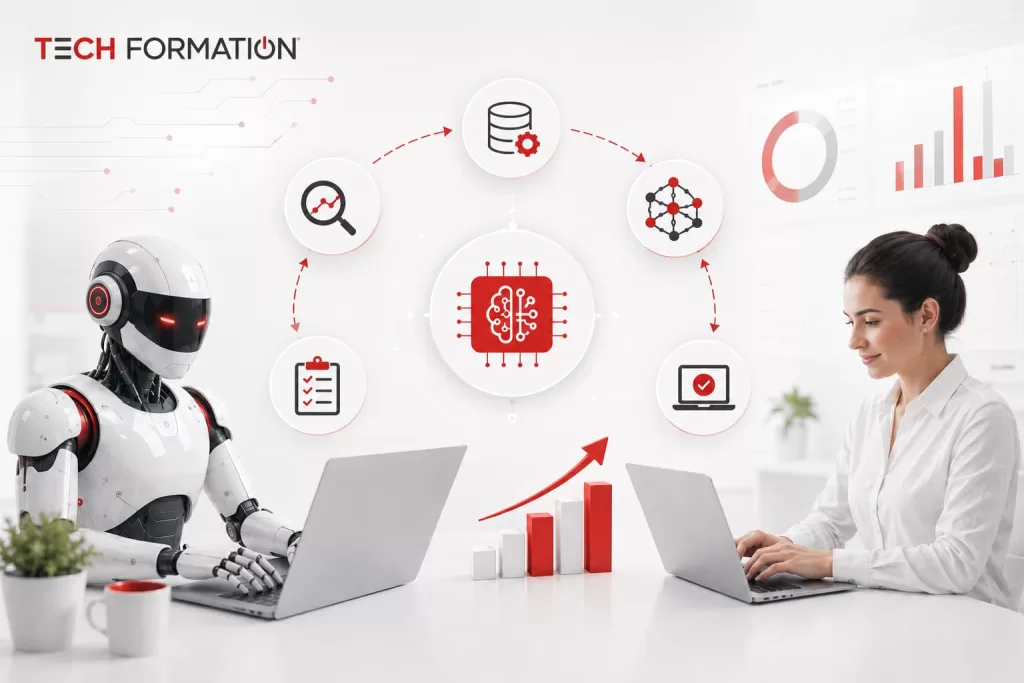
This guide explains what AI integration services are, their key benefits, common use cases, and how businesses can implement AI without adding unnecessary complexity.
What Are AI Integration Services?
AI Integration Services help businesses add artificial intelligence into their current software, platforms, and internal processes. That could mean connecting ChatGPT to a customer support workflow, using AI to summarize documents, adding predictive analytics to a dashboard, or building a retrieval system that pulls answers from your own company data.
This makes adoption easier, faster, and less risky than building a completely new product. For companies that already use CRM tools, ERP platforms, SaaS apps, or custom internal software, AI integration is often the most practical way to start.
Why Businesses Are Investing in AI Integration Services
Businesses are under pressure to do more with fewer resources. Teams are expected to respond faster, handle more requests, and deliver better customer experiences without increasing overhead. AI integration helps solve that problem by automating repetitive tasks and improving access to information.
There is also a competitive reason. Companies that adopt AI early often create a better experience for customers and employees. A support team that can answer questions faster, a sales team that can prioritize leads more intelligently, or an operations team that can process data in minutes instead of hours all gain a real advantage. That is why AI integration is no longer seen as a future trend. It is becoming part of how modern businesses operate.
Benefits of AI Integration for Businesses
AI integration can deliver measurable improvements across different areas of your business. Here are some of the key benefits:
- Saves Time: AI takes care of repetitive tasks, so teams can spend more time on important work.
- Reduces Mistakes: It helps improve accuracy in tasks like data entry, document processing, and customer support.
- Supports Business Growth: AI can handle more work as your business grows, without adding extra complexity.
- Lowers Operating Costs: Automating routine tasks helps reduce manual effort and improve efficiency.
- Improves Customer Experience: Faster responses and better service lead to happier customers.
Real-World AI Integration Use Cases
AI can be used in many parts of a business. The most common examples are:
- Customer support: Businesses connect AI chatbots to their help centers so customers can get answers quickly. This reduces support tickets and gives teams more time to handle complex issues.
- Document processing: AI can read invoices, contracts, forms, and reports, then move the information to the right system automatically. This saves time and reduces manual work.
- Sales and marketing: They also use AI to qualify leads, create content, and automate follow-ups. Operations teams use it to create reports, find information faster, and improve daily workflows.
The best results come from using AI where it solves a real problem. Instead of adding AI to everything, businesses should focus on areas where it can save time, reduce effort, and improve results.
How the AI Integration Process Works
1. Define the Business Goal
Start by identifying the problem you want AI to solve. Whether it’s improving customer support, automating repetitive tasks, or analyzing data faster, having a clear objective ensures the integration delivers real business value.
2. Evaluate Existing Systems and Data
Review your current software, workflows, and data sources. This helps determine where AI can fit into your operations and whether your data is ready to support accurate AI-driven results.
3. Choose the Right AI Solution
Select the AI model, platform, or tool that aligns with your business needs. The right choice depends on factors such as functionality, scalability, accuracy requirements, and budget.
4. Integrate AI with Existing Software
Developers connect the AI solution to your applications, databases, and workflows using APIs and custom integrations. The goal is to make AI work seamlessly within your existing environment.
5. Test and Deploy
Before launch, the solution is thoroughly tested for performance, security, and accuracy. Once validated, it is deployed into the live environment with minimal disruption to daily operations.
6. Monitor and Optimize
AI integration is an ongoing process. Regular monitoring, user feedback, and performance improvements help ensure the system continues to deliver value as business needs evolve.
Ready to Integrate AI Into Your Business?
Connect AI with your existing software, automate workflows, and unlock new efficiencies.

How Much Do AI Integration Services Cost?
The cost of AI software integration depends on the size and complexity of the project. A simple integration usually costs less than a solution that connects multiple systems, databases, and workflows.
| Integration Type | Average Cost Range |
|---|---|
| Basic AI Integration | $5,000 - $15,000 |
| Mid-Sized AI Integration | $15,000 - $50,000 |
| Enterprise AI Integration | $50,000 - $250,000+ |
Basic projects often include chatbot integration, workflow automation, or AI-powered search. Mid-sized projects may involve CRM integrations, document processing, or customer support automation. Enterprise projects usually require custom AI workflows, multiple integrations, advanced security measures, and ongoing support.
Factors That Affect AI Integration Costs
Several factors can influence the final project cost:
- Number of software systems that require integration
- Data quality, volume, and accessibility
- API availability and third-party service dependencies
- Security, privacy, and compliance requirements
- Level of customization and workflow complexity
- Use of pre-trained AI models versus custom AI solutions
- Ongoing maintenance, monitoring, and support needs
Small AI integration projects can often be completed on a modest budget. Larger enterprise projects usually cost more because they involve multiple systems, extensive testing, stronger security measures, and planning for future growth. To get an accurate cost estimate, businesses should first define their goals, understand the technical requirements, and review the systems that need to be connected before development starts.
Typical AI Integration Project Examples
| Project Type | Estimated Cost |
|---|---|
| ChatGPT Integration | $5,000 - $20,000 |
| AI Customer Support Automation | $10,000 - $40,000 |
| Document Processing & Data Extraction | $15,000 - $50,000 |
| CRM & Sales Automation Integration | $20,000 - $75,000 |
| Enterprise AI Workflow Automation | $50,000 - $250,000+ |
Challenges Businesses Face During AI Integration
AI integration sounds simple in theory, but real systems are rarely simple. One common challenge is legacy software. Older systems can be difficult to connect with modern AI tools, especially if documentation is limited or the architecture is outdated.
Data quality is another issue. If the business data is messy or incomplete, the AI output will reflect that. Security and compliance also need attention, especially when sensitive information is involved. On top of that, teams may need time to adjust to new workflows. Even a useful system can fail if people do not understand how to use it properly.
This is why AI integration should be treated as a business project, not just a technical experiment. The best results usually come from a careful rollout, not a rushed one.
AI Integration Services vs In-House AI Development
When businesses decide to use AI, they usually choose between building a solution internally or working with an AI integration provider. Building in-house can offer more control, but it often takes longer and requires more resources. AI Integration Services make it easier to add AI to existing software and workflows without creating everything from the ground up. The right choice depends on your budget, timeline, and business goals.
| Factor | AI Integration Services | In-House AI Development |
|---|---|---|
| Time to Launch | Weeks | Months |
| Upfront Investment | Lower | Higher |
| AI Expertise Required | Minimal | Dedicated AI team needed |
| Infrastructure Setup | Mostly managed | Fully self-managed |
| Development Risk | Lower | Higher |
| Customization Level | Medium to high | Very high |
For many businesses, AI Integration Services offer the quickest path to adopting AI without the complexity of building everything from scratch.
How to Choose the Right AI Integration Company
Selecting the right partner matters as much as selecting the right technology. A strong AI integration company should understand both the business problem and the technical architecture behind it. If a team only talks about tools but does not understand workflows, the final solution may look good on paper and fail in practice.
Look for a partner with real implementation experience, not just high-level AI knowledge. They should be able to explain how they handle data, testing, security, and post-launch support. It also helps if they have worked with businesses similar to yours, because industry context can make a big difference in how the solution is designed.
Conclusion
AI Integration Services are not about chasing a trend. They are about making existing systems smarter, faster, and more useful for the people who depend on them every day. When done properly, AI can reduce manual work, improve customer experience, and help teams operate with more confidence.
Whether you’re exploring AI-powered customer support, workflow automation, document processing, or custom AI solutions, the right integration strategy can deliver measurable business results. If you’re evaluating AI integration opportunities, at Tech Formation our team can help assess your existing systems, identify practical use cases, and create a roadmap tailored to your business goals.
FAQs
Can AI be integrated into legacy software?
Yes. Many legacy systems can still support AI integration with the right planning, architecture,
and phased implementation.
How long does AI integration take?
Most AI integration projects take a few weeks to a few months.
Which businesses benefit most from AI integration?
Companies with repetitive workflows, large amounts of data, or customer-facing systems often
see the fastest value from AI integration.
How much do AI integration services cost?
Costs vary based on project scope, complexity, and integration requirements.
Can ChatGPT be integrated into existing software?
Yes, ChatGPT can be integrated with existing applications through APIs.
Do I need to replace my current software?
No, AI can usually be added to existing systems without rebuilding them.
How do I choose the right AI integration company?
Look for proven experience, technical expertise, security practices, and successful project
delivery.
Are AI Integration Services suitable for small businesses?
Yes. Many small businesses start with chatbot integration, workflow automation, or AI-powered
document processing before expanding into more advanced AI solutions.
Still Have Questions About AI Integration?
Talk to our experts to discuss your requirements, timelines, and implementation options.

Article by
Pritam
Software Developer | Tech Formation
With 6+ years of experience in both frontend and backend technologies, I’m passionate about building reliable and efficient software that solves real problems. I enjoy collaborating with diverse teams to create user-friendly products that perform well and scale smoothly. Writing clean code and tackling challenges are what keep me motivated every day.
Let’s Connect and Create Something Remarkable