AI Agent vs Chatbot: Which Is Better for Your Business?
Understand AI agents vs chatbots, their differences, limitations, and which one fits your business workflows in 2026
- Introduction
- What Is a Chatbot?
- What Is an AI Agent?
- AI Agent vs Chatbot: Understanding the Real Difference
- Why Many Businesses Outgrow Chatbots
- Custom Chatbot vs SaaS Chatbot: Key Differences
- Agentic AI Platforms and Traditional Chatbot Builders: Which to Choose?
- Uses of AI Agents and Chatbots Across Different Industries
- What We Noticed While Working on Real AI Systems
- Limitations of Chatbots and AI Agents to Keep in Mind
- Final Thoughts
- FAQs

For a long time, businesses were mainly focused on adding chatbots to their websites. If customers could get quick replies without waiting for a support person, that already felt useful. But now the expectations are changing. Businesses want systems that do more than answer questions. They want something that can help with actual work happening behind the scenes.
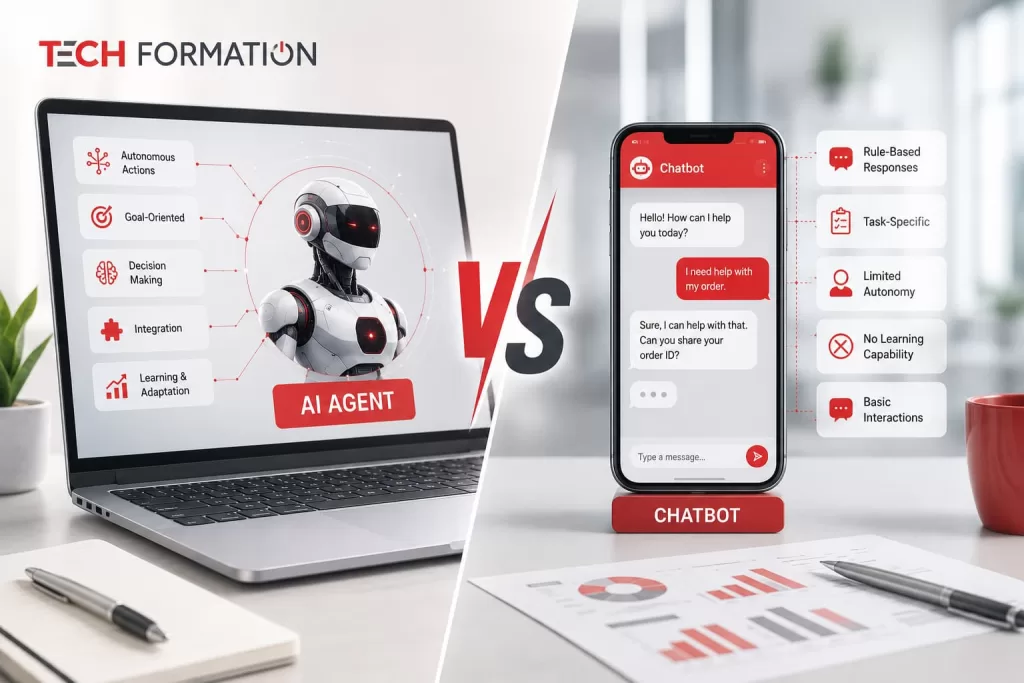
That’s why the discussion around AI agent vs chatbot has become much bigger recently. Both may seem similar at first, but the differences become noticeable once daily operations, integrations, and workflows enter the picture. A chatbot mainly helps with conversations. An AI agent is built to assist with tasks and process-related work.
So before choosing between them, it’s important to understand where each one actually fits and what kind of problem it is meant to solve.
What Is a Chatbot?
A chatbot is usually created to handle conversations with users. Someone asks a question, the chatbot reads the input, and then replies based on the setup. Some chatbots follow fixed reply patterns, while others are better at understanding different ways people naturally speak. Because of this, many businesses now compare chatbot vs AI agent options before deciding which type of system would actually help their day-to-day work better.
Chatbots work best when:
- Conversations are predictable
- Workflows are simple
- Users mainly need guidance or information
That’s why they are commonly used for:
- FAQs
- Customer support
- Lead generation
- Onboarding assistance
What Is an AI Agent?
An AI agent is generally used when businesses need more than simple conversations. Along with replying to users, it can work with connected tools, access information from different systems, and help carry out certain tasks automatically. This is why many companies move toward AI agents as daily operations start requiring more coordination and less manual effort.
AI agents work best when:
- Workflows involve multiple steps
- Systems need to work together
- Tasks require actions, not just replies
That’s why they are commonly used for:
- Workflow automation
- Operational task handling
- Internal process management
- System-based actions and coordination
AI Agent vs Chatbot: Understanding the Real Difference
The easiest way to understand the difference is to look at what happens after a user asks for something.
| Aspect | Chatbot | AI Agent |
|---|---|---|
| Main role | Handles conversations | Handles tasks and workflows |
| Focus | Communication | Action and execution |
| Workflow capability | Limited | Multi-step workflow handling |
| Integrations | Basic | Deep system integrations |
| Decision-making | Minimal | Context-aware |
| Business impact | Reduces interaction load | Reduces operational workload |
A chatbot helps users communicate with a system. An AI agent helps businesses automate work. That single difference changes how each one fits into real operations and why the debate around AI agents vs chatbots for enterprises is growing rapidly.
Why Many Businesses Outgrow Chatbots
A chatbot usually works well in the beginning because the use case is small and controlled. Over time, businesses often want more:
- Deeper integrations
- Workflow automation
- Smarter handling of requests
- Less manual involvement from teams
Custom Chatbot vs SaaS Chatbot: Key Differences
Another common decision businesses face is whether to use a ready-made chatbot platform or build a custom one. A SaaS chatbot launches faster. It works well for common use cases and doesn’t require heavy development. A custom chatbot gives more flexibility. It can be built around your exact workflow, integrations, and business needs.
Simple Comparison
| SaaS Chatbot | Custom Chatbot |
|---|---|
| Faster setup | More flexibility |
| Lower initial cost | Better workflow alignment |
| Limited customization | Full control |
| Works for common use cases | Built for specific operations |
If your workflow is simple, a SaaS chatbot may be enough. If your process is unique or integration-heavy, a custom solution usually makes more sense.
Agentic AI Platforms and Traditional Chatbot Builders: Which to Choose?
This shift is becoming more common as businesses move toward workflow automation in 2026. Traditional chatbot builders focus on creating conversation flows. You define what the chatbot should say in different situations.
Agentic AI platforms work differently. Instead of only scripting responses, they focus on outcomes and actions.
The mindset changes from:
“How should the chatbot respond?” to “How should the system complete this task?”
That’s why agentic AI platforms are becoming more popular for businesses dealing with complex workflows and operations.
Uses of AI Agents and Chatbots Across Different Industries
The difference becomes much clearer when you look at how businesses use them in real situations.
E-commerce
In e-commerce, the difference between chatbots and AI agents becomes much easier to notice once businesses move beyond basic customer conversations.
Chatbots are mostly used for customer interaction. They help users:
- Find products
- Answer common questions
- Track orders
AI agents go further by handling parts of the shopping process itself. They can:
- Recommend products based on behavior
- Process returns
- Update inventory-related information
- Automate customer workflows
Difference in E-commerce
| Chatbot | AI Agent |
|---|---|
| Assists customers | Handles workflows |
| Answer questions | Performs actions |
| Interaction-focused | Operation-focused |
Healthcare
Healthcare providers often use chatbots for basic communication. For example:
- Appointment scheduling
- Patient FAQs
- General assistance
AI agents are more useful when workflows become more operational. They can:
- Coordinate follow-ups
- Organize patient-related processes
- Connect systems and information
Difference in Healthcare
| Chatbot | AI Agent |
|---|---|
| Handles patient communication | Supports operational workflows |
| Shares information | Coordinates actions |
| Limited interactions | Multi-step process handling |
SaaS Platforms
SaaS companies often use chatbots for onboarding and support inside the product. An AI agent can become part of the platform itself by:
- Automating actions
- Assisting users contextually
- Triggering workflows inside the system
Difference in SaaS
| Chatbot | AI Agent |
|---|---|
| Helps users navigate | Helps users complete tasks |
| Interaction-focused | Workflow-focused |
| Guides users | Automates processes |
What We Noticed While Working on Real AI Systems
While working on an AI-powered SOP and task management platform at Tech Formation, we noticed something important very early in the project. Building the conversation layer was not the difficult part. The real complexity started once the system had to fit into actual business operations.
The platform was designed to centralize tasks, documentation, training material, and operational workflows in one place. At first, the idea sounded straightforward: users ask questions, and the system responds with the right information. But once real workflows came into play, the requirements changed completely.
For example, the system was not only expected to answer questions. It also needed to:
- Pull information from different documents
- Understand task-related context
- Work with operational data
- Connect actions across workflows
- Help users move work forward without confusion
To solve this, we focused heavily on workflow mapping, structured data handling, and system integrations, rather than treating the project as a standalone chatbot setup. The AI was connected carefully with operational logic so it could support tasks naturally rather than simply replying like a support bot.
That experience made one thing very clear to us: conversations are usually the easy part. The real challenge begins when AI must participate in day-to-day business operations in a reliable and structured way.
Limitations of Chatbots and AI Agents to Keep in Mind
Both options have limitations, and it’s important to be realistic about them.
Chatbot Limitations
- Struggles with complex workflows
- Limited beyond conversations
- Difficult to scale operationally
AI Agent Limitations
- More complex to implement
- Requires better integrations
- Needs clearer planning and structure
Choosing the wrong approach often creates more work later.
Final Thoughts
Choosing between a chatbot and an AI agent usually becomes much simpler once you look at the actual day-to-day work involved. Some businesses only need a system that can answer questions and guide users properly. In those cases, a chatbot often does the job without adding unnecessary complexity.
But when teams start dealing with repetitive processes, disconnected systems, or too much manual coordination, businesses naturally begin looking for something that can do more than just respond. That’s where AI agents start becoming useful.
At Tech Formation, we’ve noticed that projects tend to work better when businesses focus first on the problem they want to solve instead of chasing whatever technology is trending at the moment. In most cases, the right solution is the one that fits naturally into the workflow people are already using every day.
Planning to automate workflows with AI?
Get a quick workflow breakdown to decide between a chatbot or AI agent.

FAQs
1. Can I start with a chatbot and move to an AI agent later?
Yes, and many businesses do exactly that. Most teams begin with a simple chatbot and expand to AI agents as operations become more complex.
2. Will an AI agent replace my support or operations team?
Not completely. AI agents are best used to reduce repetitive work and speed up workflows, while human teams still handle oversight, decisions, and exceptions.
3. What usually makes AI agent implementation more expensive?
The biggest factor is workflow complexity. The more systems, integrations, and operational tasks involved, the more planning and coordination the project requires.
4. Is a chatbot enough for customer support?
For basic support, yes. A chatbot works well for FAQs, simple requests, and repetitive conversations. More advanced support workflows often require AI-agent-like capabilities.
5. Why do many chatbot projects fail to deliver long-term value?
In many cases, businesses expect chatbots to handle workflows they were never designed for. The issue is often not the technology itself, but the mismatch between the tool and the actual business need.
6. Can AI agents work with existing business software?
Yes. Most AI agents are designed to work alongside existing systems like CRMs, dashboards, support tools, and internal platforms rather than replacing them completely.
7. Which is the better option for small businesses?
That depends on the workflow. Many small businesses do perfectly well with chatbots, especially when the goal is customer communication. AI agents become useful when operations start requiring automation across multiple steps.
8. Do AI agents always use advanced AI models?
Not necessarily. In many real-world projects, the value comes more from workflow integration and system coordination than from using the most advanced model available.

Article by
Pritam
Software Developer | Tech Formation
With 5+ years of experience in both frontend and backend technologies, I’m passionate about building reliable and efficient software that solves real problems. I enjoy collaborating with diverse teams to create user-friendly products that perform well and scale smoothly. Writing clean code and tackling challenges are what keep me motivated every day.
Let’s Connect and Create Something Remarkable