AI in E-commerce: The Future of Smart Shopping 2026
From personalized recommendations to AI agents, see how businesses are using AI
to create smarter shopping experiences and improve operations.
- Introduction
- What Is AI in E-commerce?
- How AI Is Changing E-commerce in 2026
- 7 Practical AI Use Cases in E-commerce
- Benefits of AI for E-commerce Businesses
- Which AI Use Case Should an E-commerce Business Start With?
- Challenges of Implementing Artificial Intelligence in E-commerce
- How to Implement AI in an E-commerce Business
- How Much Does AI in E-commerce Cost?
- AI for Small E-commerce Businesses
- Future of AI in E-commerce
- Conclusion
- FAQs

Ask a chatbot for sizing advice. Watch a product page rearrange itself based on what you clicked a minute ago. Get a price that’s slightly different from what your friend saw yesterday. This is what shopping looks like now, and AI is running quietly underneath most of it.
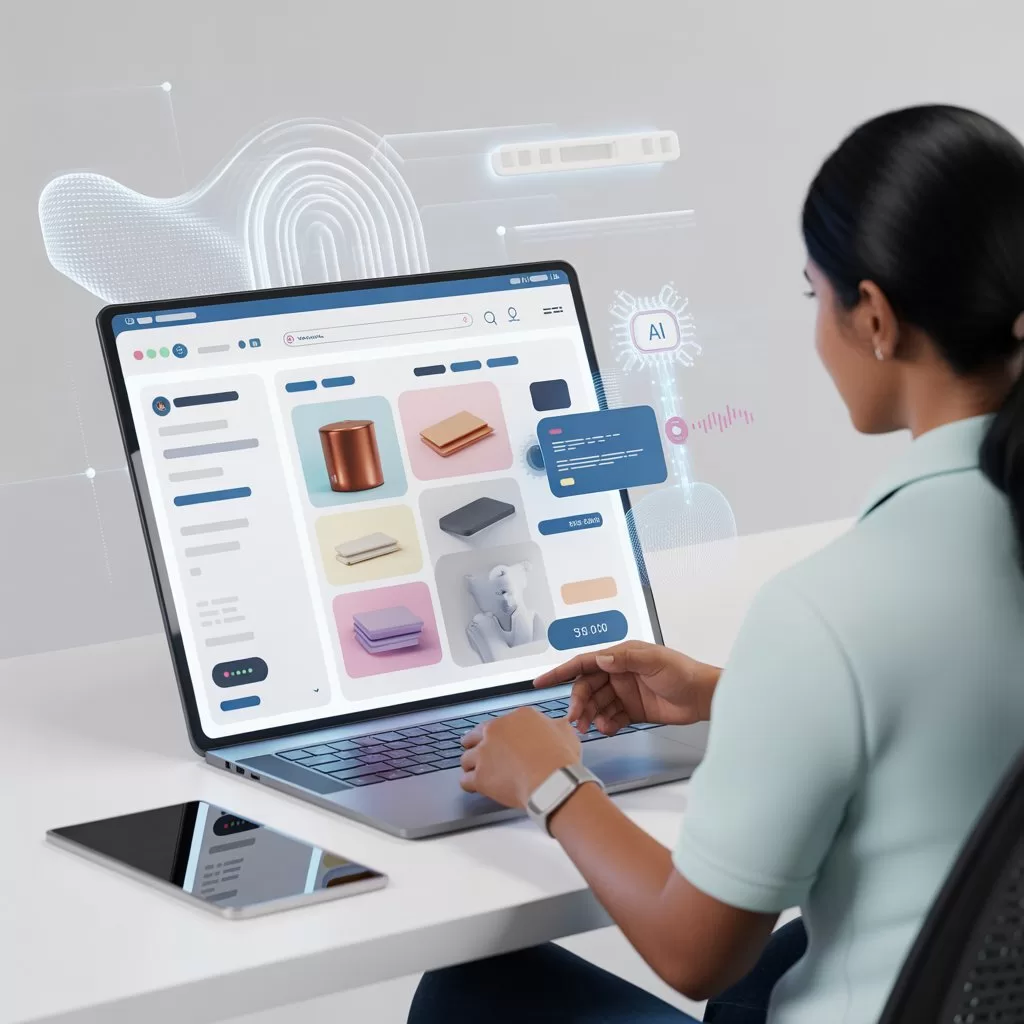
AI in e-commerce isn’t a future trend anymore - it’s infrastructure. It shapes how products get discovered, how prices move, how support tickets get answered, and how fraud gets stopped before it costs anyone money. This guide breaks down what AI in e-commerce actually means today, which use cases are worth your time, what they cost, what gets in the way, and where things are headed next.
What Is AI in E-commerce?
At its core, AI in e-commerce means using machine learning and natural language processing to make sense of customer, product, and transaction data - then act on it in real time. A human doesn’t have to decide which products to feature or answer every support ticket one by one. The system learns patterns and handles a lot of that on its own.
There’s a real difference between this and plain automation. A rules-based system follows fixed instructions: if the cart total passes $100, offer free shipping. An AI-driven system notices things a rule wouldn’t catch - maybe that offer converts better with first-time visitors than returning ones - and adjusts on its own.
How AI Is Changing E-commerce in 2026
A few years ago, AI in e-commerce mostly meant static recommendation widgets. Now it covers demand forecasting, AI-written product content, natural-language customer conversations, and early versions of AI agents that can complete parts of a purchase on their own.
McKinsey’s latest global survey found that 88% of respondents said their organizations regularly use AI in at least one business function, up from 78% a year earlier. However, most organizations are still in the experimentation or piloting stages.
7 Practical AI Use Cases in E-commerce
-
Personalized Product Recommendations:
This is the one most shoppers already recognize - suggested products based on what someone’s browsed or bought before, or what similar customers liked. The payoff is usually a higher average order value and better repeat-purchase rates, since people find what they want faster instead of scrolling through an entire catalog.
-
Conversational Shopping Assistants:
A shopper types a question - about sizing, stock, or where their order is - and gets a real answer instead of digging through an FAQ page. These run on language models trained on a store’s catalog, policies, and support history, and they hand off anything complicated to a human agent. The upside is faster response times and support that doesn’t sleep, without needing to triple the size of the support team. Fashion retailers use this well, helping shoppers pick a size based on how previous buyers said an item actually fit.
-
Dynamic Pricing and Merchandising:
Prices and product placement shift based on demand, stock levels, competitor pricing, and who’s browsing. The model watches signals like sell-through rate and competitor feeds, then nudges prices up or down within limits the business sets. Done well, this protects margin and clears slow-moving stock before a bigger markdown is needed. A retailer might quietly raise a price during a demand spike on one item while discounting another that’s not moving.
-
Fraud Detection:
Orders get scored for risk in real time, before they’re approved - catching patterns a static rules engine would miss. This matters more than people realize: Juniper Research’s 2024 forecast projected that e-commerce fraud losses would rise from $44.3 billion in 2024 to $107 billion by 2029, an increase of 141%. A mismatched shipping address paired with an unusual purchase pattern gets flagged for review instead of turning into a chargeback later.
-
Personalized Marketing:
Email, ads, and on-site messages get tailored to a segment - or increasingly, to one person - based on behavior and predicted intent. A cart-abandonment email sent to a first-time browser reads differently than one sent to a loyal repeat customer, and it’s timed differently too. The result is marketing spend that goes further because the message actually matches where someone is in their decision.
-
AI-Powered Search & Visual Discovery:
Traditional search relies on exact keywords, but AI-powered search understands natural language, shopper intent, and product attributes. Customers can find products faster using conversational queries or even images. Visual search allows users to upload a photo and discover similar products, improving product discovery, engagement, and overall shopping experiences.
-
Demand Forecasting & Inventory Optimization:
AI analyzes sales history, seasonality, and customer demand to predict future inventory needs. Better forecasts help retailers avoid stockouts, reduce excess inventory, and improve cash flow, while keeping popular products available when customers are ready to buy.
Benefits of AI for E-commerce Businesses
The gains show up in a few consistent places:
- Faster, more relevant shopping experiences that reduce drop-off
- Easier product discovery, so customers aren’t digging through irrelevant results
- Higher conversion rates from better-targeted recommendations
- Stronger retention, since personalization gives people a reason to come back
- Less manual work on routine tasks like support triage and basic reporting
- Better inventory calls, fewer stockouts and less dead stock
- Faster support response times without proportional headcount growth
Capital One Shopping reports that 69% of retailers that implemented AI saw revenue increases directly attributable to AI, while 72% used AI to reduce costs. Worth treating as a directional signal rather than a guarantee - your results will depend on data quality and how well the use case fits your actual problem.
Which AI Use Case Should an E-commerce Business Start With?
Skip whatever’s trending and start with whatever’s actually hurting your business. A few questions help narrow it down:
- High cart abandonment or weak conversion? Start with recommendations or a conversational assistant that removes friction at the decision point.
- Support team drowning in repeat questions? A chatbot trained on your FAQs and order data gives fast, visible relief.
- Margins getting squeezed by manual pricing? Dynamic pricing is the more direct fit.
- Chargebacks climbing? Move fraud detection up the list.
One well-scoped use case, proven and then expanded, beats trying to bolt AI onto everything at once.
Challenges of Implementing Artificial Intelligence in E-commerce
None of this is plug-and-play. The common sticking points:
- Data quality: Messy or siloed data undermines a model before the project even starts.
- Integration: Connecting AI tools to your existing platform, CRM, and inventory system usually takes longer than building the AI part.
- Unclear ROI: Many teams struggle to put a number on AI’s value upfront, which makes prioritizing hard.
- Talent gaps: Getting from a demo to something production-ready often needs outside help.
- Security: Any AI system touching payment or customer data carries real privacy risk - and attackers are using AI too, so the threat side is evolving just as fast.
None of these are reasons to sit AI out. They’re reasons to plan the rollout instead of rushing it.
How to Implement AI in an E-commerce Business
- Pick the use case that fits it: Match the tool to the problem using the guidance above.
- Audit your data: Confirm it’s clean enough and accessible enough for a model to learn from.
- Plan the integration early: Connecting to your e-commerce platform, CRM, ERP, and support tools is usually where timelines slip - AI integration work is worth budgeting for properly.
- Pilot before you scale: Test against real customer behavior on a limited rollout first.
- Measure the metric that mattered from step one: Conversion, ticket volume, fraud losses - whatever the original problem was.
- Scale what actually worked: Expand to more of the catalog or more channels once the results hold up.
How Much Does AI in E-commerce Cost?
There’s no single number here - it depends entirely on the use case and how you build it. Off-the-shelf tools are the cheapest entry point: basic chat widgets or recommendation plugins through app marketplaces:
| AI E-commerce Solution | Typical Development Cost | Main Cost Factors |
|---|---|---|
| AI Chatbot | $5,000 - $30,000+ | LLM/API usage, product data, order integration, support workflows |
| AI Product Recommendations | $10,000 - $60,000+ | Customer data, personalization, recommendation logic, real-time processing |
| AI-Powered Search | $8,000 - $50,000+ | Catalog size, semantic search, filters, ranking, integrations |
| AI Personalization | $15,000 - $75,000+ | Customer segments, behavioral data, channels, experimentation |
| Dynamic Pricing | $20,000 - $100,000+ | Competitor data, demand signals, pricing rules, real-time processing |
| Fraud Detection | $30,000 - $100,000+ | Transaction data, risk models, monitoring, security requirements |
| AI Shopping Agent | $20,000 - $150,000+ | Multi-step workflows, product/catalog data, APIs, cart and checkout integration |
| Custom AI E-commerce Platform | $80,000 - $250,000+ | Number of AI features, architecture, integrations, scale, security |
Note: These ranges are based on typical custom-development scope, integration complexity, data requirements, model/API usage, security requirements, and deployment needs. They are not vendor pricing or fixed project quotes.
AI for Small E-commerce Businesses
Smaller e-commerce businesses do not need to build a complex AI platform from day one. A better starting point is usually one focused problem with a measurable outcome, such as reducing support volume, improving product discovery, recovering abandoned carts, or automating routine content work.
At the same time, custom development becomes more useful when the business has enough data and a proven use case to justify deeper integration. For businesses ready to move beyond off-the-shelf tools, AI product development can help turn a proven use case into a scalable solution.
The key is to start small, measure the result, and expand only when the numbers show that the use case is creating real value. This approach also reduces integration risk and gives teams time to establish data, privacy, and governance practices before deploying more autonomous AI.
Future of AI in E-commerce
For businesses exploring these workflows, AI agent development can help turn individual AI capabilities into connected, task-oriented systems. Many e-commerce companies are already preparing for this shift, while major commerce platforms are also investing in AI-assisted discovery and agentic shopping, making it easier for shoppers to research products, compare options, and increasingly complete parts of the buying journey through AI.
Beyond agentic shopping, AI is also making other shopping experiences more interactive. Voice shopping can help customers search for products, ask questions, and receive recommendations using natural language. Augmented reality and virtual try-ons can also help shoppers visualize products such as clothing, accessories, and makeup before making a purchase.
The retailers who come out ahead will treat AI as core infrastructure rather than as a feature they simply add to the business.
Conclusion
The businesses actually getting something out of AI in e-commerce aren’t chasing every new tool that launches. They’re starting with a real problem and matching it to the use case that solves it. Recommendations, conversational support, AI-powered search, demand forecasting, dynamic pricing, fraud detection, and marketing automation are all practical starting points. The question is which one solves your problem right now.
If you’re trying to figure out where AI could genuinely move the needle for your store, talk to Tech Formation about mapping the right use case to your systems and budget - or take a look at our past work first.
FAQs
1. How long does it take to implement an AI solution?
Timelines vary based on the complexity and scope of the project. A simple AI chatbot can be implemented in days, while custom recommendation engines may take a few weeks.
2. Is customer data safe when using AI?
Yes, responsible AI implementation includes data encryption, compliance with privacy laws like GDPR, and transparent data practices.
3. What are the best AI tools for e-commerce?
Some leading tools include Google Cloud AI, Microsoft Azure AI, IBM Watson, Shopify AI integrations, and custom solutions built with Python or Node.js.
4. Is AI expensive for small e-commerce businesses?
Not necessarily. Many AI tools offer scalable pricing or pay-as-you-go models.
Small businesses can start with basic AI features like chatbots or recommendation
engines.
5. Can AI predict what customers will buy?
Yes. AI uses historical purchase data, browsing behavior, and trends to forecast buying patterns and suggest products customers are most likely to purchase.
Ready to put AI to work in your e-commerce business?
Get expert guidance on the right solution for your goals, budget, and existing systems.


Article by
Shweta Rajput
Business Development Executive | Content Strategist at Tech Formation
Shweta drives business growth and brand communication at Tech Formation by aligning strategic content with client-focused development. Backed by a strong foundation in content creation, the role focuses on enhancing market presence, shaping impactful narratives, and supporting meaningful business engagement.
Let’s Connect and Create Something Remarkable